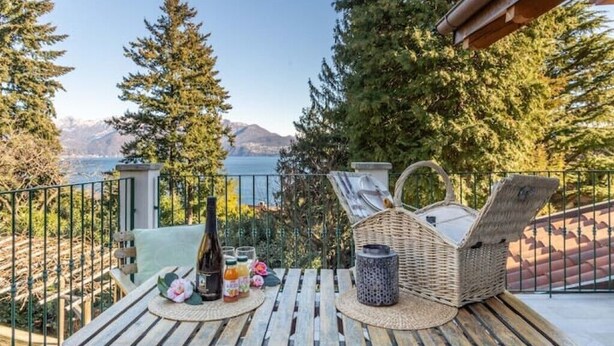
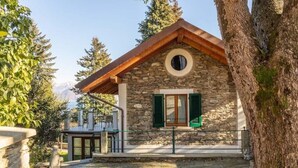
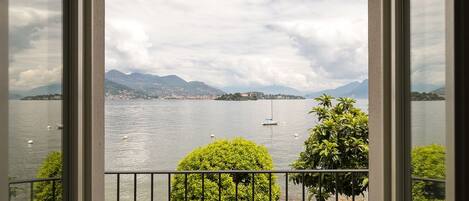
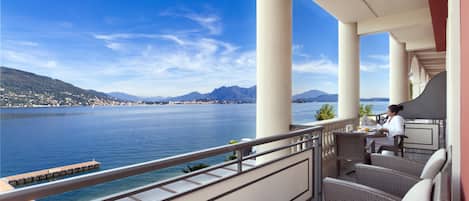
The first floor of the Gardener's Cottage: a studio flat with high ceilings, born in the nineteenth century, overlooking the historic botanical garden of Villa Anelli. The terrace offers views of the spring blossoms, the castles of Cannero in summer, and the lake in every season.
It is not a picture-postcard view. It is the view enjoyed by those who actually live here.
THE SPACE
This studio is located on the first floor of a recently restored nineteenth-century country house, set within the historic garden of Villa Anelli — a private arboretum featuring one of the most significant camellia collections in Italy, recognised as an International Garden of Excellence by the ICS — International Camellia Society — since 2010, and an open-air museum within the Upper Lake Maggiore Museum Network.
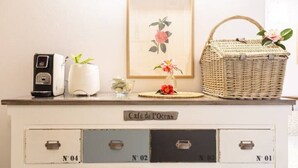
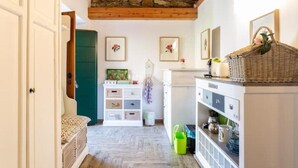
The studio is well-maintained and thoughtfully equipped: king-size bed, fold-away kitchen with induction hob and full crockery, wardrobe, bathroom, and — above all — an abundance of natural light that changes with the hours and the seasons. The ceilings are high. The proportions are honest. Nothing has been added for effect.
The terrace is the heart of the apartment. In spring it overlooks the blooming camellias — hundreds of them, in colours that range from white to deep crimson. In summer, the garden settles into its fullest green, and the view opens towards the castles of Cannero on the far shore of Lake Maggiore. In autumn, the maples and the late-flowering sasanqua hold the colour a little longer. In winter, the sasanqua are still in bloom, and the lake lies flat and silver below.
Four seasons. One terrace. No two mornings the same.
ACCESS
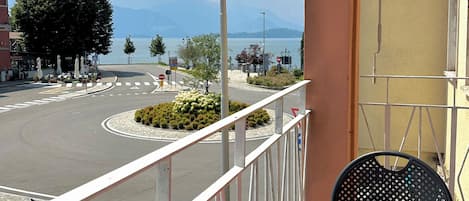
The studio is reached via a private staircase, through a gate onto a pedestrian lane just below Piazza Italia — next to the small public garden, which serves as a neighbourhood playground. The lane is short but steep. The path and the gate are lit at night.
Access is exclusively on foot. The apartment has no car access — this is part of what makes it quiet. Piazza Italia is a two-minute walk: you will find the VCO bus stop, a bar, a pharmacy, and a small food shop. The lake is ten minutes on foot. Free public parking with time restrictions is available in the square itself; a few bends further up the hill, there is free parking with no time limit.
THE GARDEN
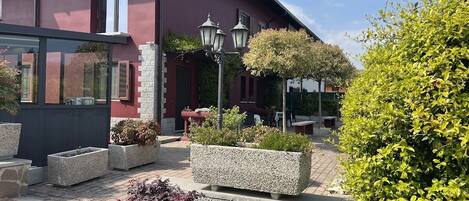
Guests have free access to the garden of Villa Anelli. From the terrace and the ground floor, a private corner of the garden is directly accessible. Friends are welcome to spend the day in the garden — we simply ask for advance notice so we can prepare.
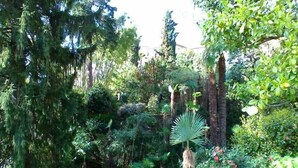
The garden is an award-winning arboretum with a collection that flowers throughout the year. Over 318 colourful Japonica cultivars light up the hillside in spring. Forty Sasanqua carry warm copper and rose tones through the winter months. Precious tea plants — Camellia sinensis, the very species from which all tea is made — bloom quietly in September. Reticulate and rare botanical species complete the camellia collection, which has been built and refined over more than a century.
Beyond the camellias: bamboo groves, azaleas, rhododendrons, Japanese maples, hydrangeas, conifers, aromatic herbs, and water features fed by the Rio Paradiso, the small stream that crosses the property. There are private corners with wrought-iron tables overlooking the lake, and a vegetable garden where guests are welcome to pick whatever is in season.
This is not a garden designed to impress. It is a garden that has been tended, loved, argued over, and cared for across four generations. The difference is visible — and it is felt.
EXPERIENCES
On request, we organise:
Botany and gardening workshops with Andrea Corneo, agronomist. Andrea was born and raised in this garden. He is one of Italy's foremost experts on camellias and the current president of the Società Italiana della Camelia. A workshop with him is not a guided tour. It is a conversation between someone who knows every plant by name and someone who is genuinely curious. He will show you propagation techniques, explain the difference between a Japonica and a Reticulate, and — if the timing is right — let you take home a cutting.
Participatory decoration and sensory workshops with Orsola. Orsola is a sommelier, a student of Sociology of Tourism and Local Communities, a member of the International Art Guild and the World Egg Artist Association, and a passionate advocate for the slow pleasures of the Upper Lake Maggiore. Her workshops in the garden range from wine tasting with local and estate wines — including the family's own DOC labels from Lake Garda — to EggArt, the centuries-old tradition of decorating eggshells that Orsola has practised and taught for years. The sessions are participatory: you do not watch, you make.
We also provide a comprehensive guide to local attractions: restaurants that the locals actually use, walking trails suited to every level, historic gardens in the vicinity, and preferential rates with guides for excursions in the Val Grande National Park and the surrounding valleys.
Bicycle parking and e-bike charging are available on request.
WHO WE ARE
We are Orsola and Andrea. Villa Anelli is the heart of our family — we come here every week from Milan, and each time the garden has something new to reveal.
The name La Camelia d'Oro comes from an extremely rare plant, the Camellia chrysantha, planted here in the 1960s by the previous owners of Villa Anelli. It blooms once every five years: a single small yellow flower, simple and fleshy, on a tall upright stem with glossy, deeply veined leaves. Anyone who sees it remembers it forever. The same name appears in James Clavell's novel Shogun — the inn where the protagonist finds rest with his beloved, at the most intense moment of his life. A secluded buen retiro, hidden from the world.
For us, La Camelia d'Oro means exactly that: a place loaded with history and meaning, quiet and rare, where time slows down and the view is never less than extraordinary.
Andrea, agronomist and president of the Società Italiana della Camelia, was born in this garden. He has travelled across the world in search of plants — Japan, China, New Zealand, Portugal — and brings that knowledge back to Oggebbio every time. When he is not in the garden, he is on the mountain bike trails of the Upper Lake Maggiore, exploring places that do not appear on any map.
Orsola was born in Verona, married into this garden, and has never looked back. Sommelier, student of Sociology of Tourism, theatre enthusiast, and dedicated practitioner of EggArt — she is the person who will make sure your stay feels like it was designed for you personally. She will tell you which restaurant opens on Tuesdays, which path is worth the climb, and which wine to drink with the local cheese.
With us: Carlo Annibale, sixteen, and Fiammetta, ten — who follow their parents everywhere, and already know the garden better than most adults ever will.
Villa Anelli has been recognised as an International Garden of Excellence by the ICS since 2010. It is an open-air museum within the Upper Lake Maggiore Museum Network, a certified educational farm registered in the Piedmont Regional Register, situated on the Via delle Genti, the Via Borromea, within the San Carlo pilgrimage circuit and the GTA — Grande Traversata delle Alpi, the great crossing of the northern Piedmont Alps.
Not just any spot on the lake. A landmark for walkers, for lovers of historic gardens, for those who want to pause and mean it.
We are here to make your stay more authentic: the right path, a meal you will not find on Google, a morning in the garden with the agronomist — or a sunset from your terrace with the castles of Cannero turning gold across the water.
GOOD TO KNOW
The garden of Villa Anelli is on a steep hillside, crossed by the Rio Paradiso stream. The internal paths are beautiful but demanding — some sections are exposed. The village of Oggebbio is largely pedestrianised and uphill. This place is ideal for those who enjoy walking and are comfortable moving carefully in natural surroundings. We recommend it warmly, and honestly.
Tourist tax: €1 per person per night, payable on arrival.
The tap water in Oggebbio has a history. For years it was bottled, distributed, and recognised for its quality. Then the bottling cycle came to an end — not because the water had become any less good, but because the world around it had changed. That same water now flows straight from your tap. It is drinkable. It is good. It is local. Turning on the tap in Oggebbio is not a compromise: it is an act of continuity with a history that has been going on for decades — and it supports the local area. Bring a reusable water bottle. Fill it at the tap. That is what the people of Oggebbio have always done — and what the Agenda 2030 recommends too.
The ground floor of the Cottage is available as a separate listing — ideal for groups or families who wish to rent both apartments together.