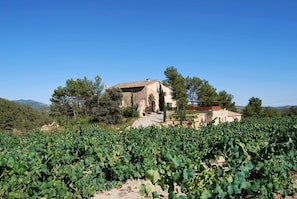
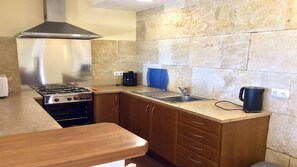
Near Barcelona, in the heart of the picturesque Penedès wine region, in a secluded former winery—where a Spanish artist (sculptor) now lives and works with his German wife and two dogs —with a fantastic panoramic view of the Garraf Nature Reserve and the sea in the distance—is a beautiful, comfortable holiday rental for two people, located near the beach (20 km to the sea), featuring a large living and dining room, an open kitchen with a counter, and fully equipped. There is a bedroom with a queen-size bed (160 x 200 cm) for two people and a bathroom. All rooms have large south-facing windows opening onto the beautiful, spacious terrace overlooking the vineyards (sun awning, patio furniture, lounge chairs)<br><br>Can Maginet is situated in a completely secluded location, approximately 1 km from the hamlet of Les Gunyoles d’Avinyonet. <br><br>Please note if arriving by car: The final stretch from the village (approx. 900 m) to our property is an unpaved farm road.<br><br>The Can Maginet holiday rental is also a wonderful destination for Christmas, New Year’s Eve, and New Year’s Day, as the apartment is very cosy—even during the cooler months—and features oil-fired central heating.<br><br>SITGES:<br>By the end of the 20th century, thanks to the initiative of artists, cultural figures, and patrons such as Santiago Rusiñol, Ramón Casas, Miquel Utrillo, and Charles Deering, Sitges became a hub and centre for the dissemination of Catalan Art Nouveau, or Modernisme. In the late 19th and early 20th centuries, painters, sculptors, musicians, and intellectuals were active in the city, and their legacy continues to shape it to this day. Today, Sitges is best known for its cultural heritage and cosmopolitan character, and will therefore continue to be a magnet for artists and cultural figures from around the world.<br><br>TARRAGONA:<br>According to legend, the god Jupiter left his wife, the mortal Tiria, when he fell in love with the city of Tarragona. Historical records indicate that in 218 B.C., the Romans established a strategic settlement at the site that would later become the capital of Hispania Citerior. A rich heritage of architectural monuments remains from this golden age, including the remains of the wall surrounding the upper city, the forum, the amphitheatre, the aqueduct, the Tower of the Scipios, and the Arch of Berà, to name just a few. UNESCO has designated these historic sites as a World Heritage Site. A stroll along the Ramblas, through the Old Town, or to the Balcó del Mediterrani makes it clear why Tarragona is considered one of the most pleasant and charming cities on the Spanish Mediterranean coast.<br><br>Travel time: 40 minutes<br>Mode of transport: car, train<br><br>The Palau Novella Buddhist Monastery in PLANA NOVELLA, in the heart of the Garraf Nature Reserve:<br>At the Garraf Buddhist Monastery, a guided tour of the Palau Novella is highly recommended; it showcases, on the one hand, the legacy of a family of “Indianos” (returnees who made their fortunes in Latin America) who commissioned the building, and, on the other hand, an exhibition of Tibetan art and culture that introduces us to a thousand-year-old spiritual tradition of Buddhist philosophy. Visitors can also participate in various workshops and lectures on relaxation techniques and meditation.<br><br>The monastery’s inspiring atmosphere and its privileged location in the heart of the Garraf Natural Park allow us to experience peace and harmony. The gardens feature the “Namgyal” stupa, which embodies the “enlightened mind” or “awake consciousness” of the Buddha. There is also a romantic lake near the monastery.<br><br>Travel time by car: 30 minutes<br>Accessible: by car, on foot.<br><br>MONTSERRAT MONASTERY:<br>Montserrat is an extraordinary place due to its setting in a unique landscape, its significance as a religious centre, and the many works of art it houses. This mountain, an impressive mass of rock smoothed by erosion, is the sacred mountain of Catalonia, which was designated a nature park in 1987. In the sanctuary, visitors can admire the Romanesque statue of the Virgin of Montserrat, known as La Moroneta because of her dark skin tone, who was proclaimed