Step inside a family home in Tissamaharama village, just minutes from Yala National Park, and spend a morning learning to cook Sri Lanka's most beloved meal — rice and curry — the way it has been made in this region for generations.
Your experience begins in the garden. Before a single pot is lit, you walk through the property with your host, discovering the plants that form the backbone of Sri Lankan cooking. Fresh curry leaves growing on the branch. Pandan leaves whose fragrance fills the kitchen before you even touch them. Lemongrass, rampe, and the turmeric root pulled straight from the soil. You smell, touch, and taste as you go — this is not a lecture, it is a conversation between you and the landscape that feeds this village. Your host explains how each plant grows, how it is harvested, and why it matters in the pot. Guests who have spent a week eating Sri Lankan food suddenly understand why everything tasted the way it did.
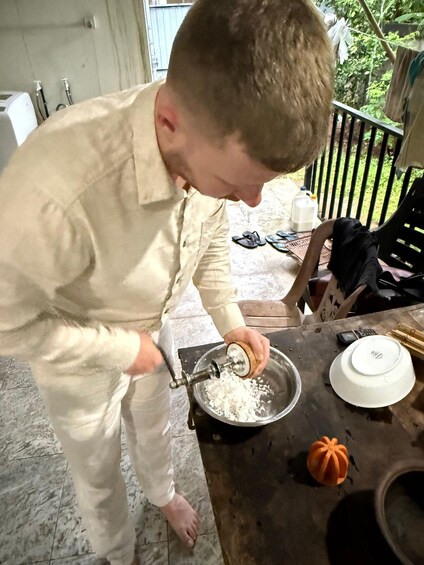
Next comes the coconut. A fresh king coconut is opened for you to drink straight from the palm — cool, sweet, and unlike anything sold in a bottle. Then you learn to scrape the flesh from a mature coconut using the traditional scraper, a skill that sits at the heart of Sri Lankan home cooking. The coconut milk you make with your own hands goes directly into the curry you are about to prepare. Nothing in this kitchen comes from a tin.
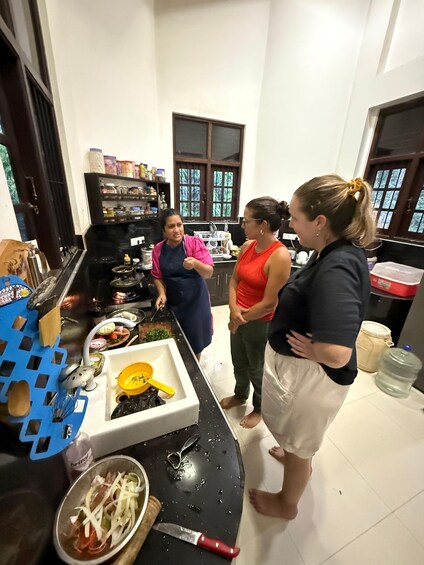
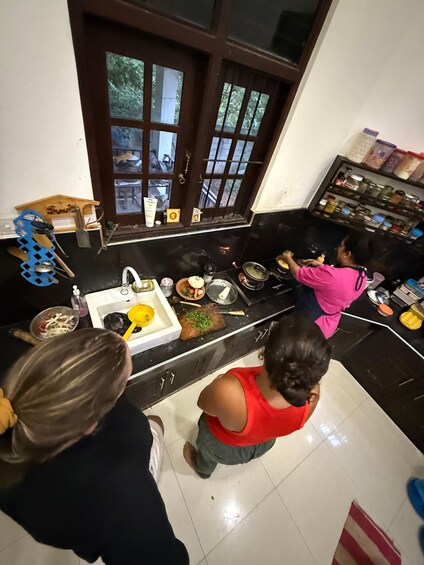
At the kitchen, your host guides you through the preparation of a full Sri Lankan rice and curry — chicken or fish, your choice — using fresh ingredients from the garden and the spices of the Ruhunu region. You learn the order of tempering, how to build layers of flavour with mustard seed, curry leaf, and dried chilli, and why the coconut milk goes in last. You learn to cook the rice the Sri Lankan way — washed, measured by knuckle, and rested before serving. By the time the meal is ready, you understand not just the recipe but the logic and the love behind it.
While the food is cooking, your host shares a few phrases in Sinhala — how to greet someone, how to say you are hungry, how to compliment the cook. Simple things that will open doors for the rest of your time in Sri Lanka and make locals smile when you use them.
Then you sit down and eat what you made. The meal is served the way Sri Lankan families serve it — everything on the table at once, rice at the centre, curries and sambols arranged around it. You eat slowly. There is no rush.
The class runs for approximately three hours. Transport from your accommodation is arranged for you — your host coordinates a tuk-tuk or taxi so the logistics are handled before you arrive. This is a small, private experience — not a group class or a hotel demonstration kitchen, but a real home, a real family, and a meal that is entirely your own work.