


Earn OneKeyCash when you sign in and book an activity
Brno: 3-Hour History & Legends Walking Tour
By Carcatta
Reviews
8.68.6 out of 10
Excellent
8.68.6 out of 10
Excellent
Free cancellation available
includes taxes & fees
per adult*
*Get a lower price by selecting multiple adult tickets
Features
- Free cancellation available
- 3h
- Mobile voucher
- Instant confirmation
- Multiple languages
Overview
A three-hour walk through the historic centre of Brno, combining informal commentary with engaging audio stories.
We will show visitors local statues from somewhat unusual angles and reveal the nicknames given to them by the people of Brno.
In a friendly, relaxed atmosphere and at a comfortable pace for all ages, we visit places where history unfolded.
At the end, we give practical tips on where to go next—whether to see more sights or enjoy a good beer.
Small groups of up to six people allow us to provide near-individual attention to each participant.We look forward to seeing you.
Activity location
- Socha Odvaha
- Moravske nam. 611/6
- 602 00, Brno, Czech Republic
Meeting/Redemption Point
- Equestrian Statue of Margrave Jobst of Luxembourg
- 6 Moravské náměstí
- 602 00, Brno-střed, Jihomoravský kraj, Czechia
Check availability
Brno: 3-Hour History & Legends Walking Tour
- 3h
- English
Price details
£47.39 x 1 Adult£47.39
Total
includes taxes & fees
*Get lower prices by selecting more than 2 adults
Until Mon, 12 Oct
What's included, what's not
- Friendly, knowledgeable local guide.
- Audio guide available at selected stops.
- Individual approach and small-group attention. Guide can offer practical tips on other sights.
- Food & drinks
- Entry or admission fees — paid entrances are not included in the tour; if participants choose to visit paid sites, they cover the costs themselves.
Know before you book
- Service animals allowed
- Public transport options are available nearby
- Not recommended for travellers with spinal injuries
- Not recommended for travellers with poor cardiovascular health
- Suitable for all physical fitness levels
- In accordance with EU regulations about consumer rights, activities services are not subject to the right of withdrawal. Supplier cancellation policy will apply.
- This activity is provided by a professional trader (a party acting within their trade, business or profession).
Activity itinerary
Socha Odvaha
- 15m
Moravian Square, dominated by the bronze equestrian statue of Jobst (Jošt) of Moravia—an eight-meter monument to the powerful medieval statesman (1351–1411),
nephew of Roman Emperor Charles IV—opens our three-hour tour. We will reveal this statue to you from somewhat unusual angles, thanks to which it has become popular.
We'll take a closer look at Marius Kotrba's sculpture 'Justice' and I'll tell you the cheeky nickname locals use for it
We’ll cover where the name “Brno” comes from, how its medieval core developed, and its geographic position in the Czech Republic.
From us you’ll learn who lived here, past and present, and hear about the Jewish and German communities and how 20th-century events reshaped the city.
Finally, we will show you Brno as a modern and young city full of students and mention key industrial companies.
Výčep Na Stojáka
- 2m
A moment ago, we passed the Scala cinema, one of the oldest cinemas in Brno, which has been operating since 1929.
Today, it is run by Masaryk University and is particularly popular among students. It screens classic films, European productions, and themed retrospectives.
And now we find ourselves in front of Výčep Na Stojáka, a pub whose name literally means “standing taproom”, where guests enjoy their beers at tall tables or right on their feet — just as the tradition of standing pubs goes back to the 1920s and 1930s.
It serves a wide range of Czech craft beers, including its own legendary Stojácké Poupě, and is known for a lively atmosphere in the heart of Jakubské náměstí.
There are no chairs inside, so people stand or spill out onto the square, blending beer, conversation, and people-watching.
It’s a perfect example of the Czech beer culture that locals and students still love today.
St. James Church
- 15m
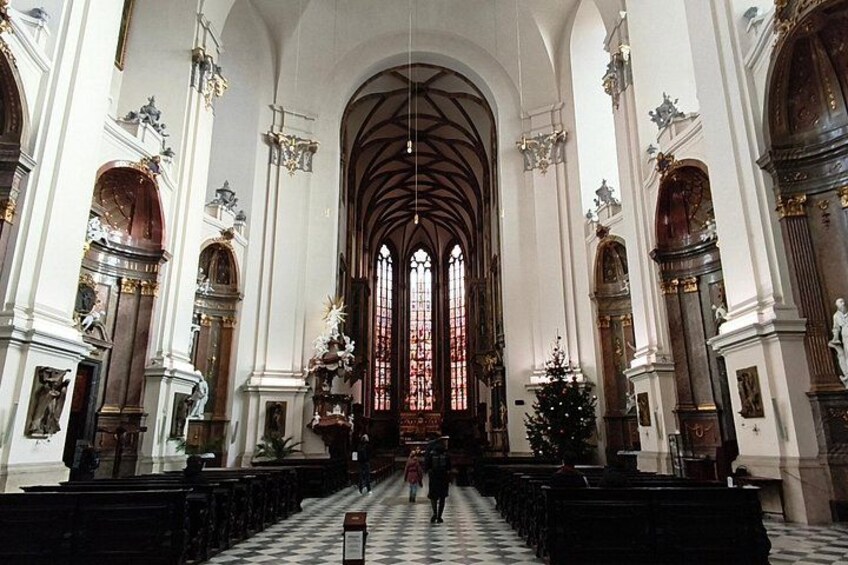
We’ll step inside the Gothic Church of St. James to admire its tall nave, ribbed vaults, historic altars, Baroque details, and impressive organ.
Inside, you’ll find the tomb of Louis Raduit de Souches, the famous commander who led Brno’s successful defence in 1645 and was later buried here.
Above the square, the church tower rises to about 92–94 metres. On the south side of the exterior, look out for the cheeky figure locals call Nehamba (Shameless) – a small man showing his backside to passersby.
Beneath the church lies the Ossuary, the second-largest in Europe, containing the remains of many victims of epidemics and war.
If you wish to visit the Ossuary or the church tower, you may do so independently, but separate tickets are required.
Admission to the Ossuary and church tower is not included in the tour price.
Hotel Avion Brno
- 7m
The next stop is Hotel Avion, a key example of Brno’s interwar functionalist architecture.
Hotel Avion was designed by Czech architect Bohuslav Fuchs and built on a very narrow plot in 1928. It is one of the narrowest hotels in Europe and a national cultural monument.
Functionalism was a major force in Brno’s architecture in the 1920s and 1930s, and here we’ll introduce you to some of its key figures and significant buildings. Architects like Fuchs adapted modern design principles to local conditions, creating buildings that are both practical and elegant.
The most famous example of refined functionalism is the Tugendhat Villa, now listed on the UNESCO World Heritage List.
It is possible to book a guided tour of Hotel Avion; you can do so independently, but separate tickets must be purchased.
Admission to the hotel is not included in today’s tour price.
Stopkova Plzeňská Pivnice
- 2m
This historic pub is a classic part of Brno’s food and beer culture. It has stood here since the late 19th century and became famous under host Jaroslav Stopka from 1910. Period ads even claimed you could get the best Pilsner Urquell beer on tap here.
Stopkova serves traditional Czech cuisine and a range of beers, including Pilsner Urquell and other local brews, making it a good short stop to experience Czech gastronomic traditions.
This is a brief stop to enjoy atmosphere, food, and beer. If you want, we can stop here after our tour ends.
Namesti Svobody
- 5m
Our next stop is Freedom Square (Náměstí Svobody), the main square of Brno. It brings together many layers of the city’s history and architecture.
Here you will see the building of Komerční banka with its striking functionalist façade, designed by Bohuslav Fuchs together with Ernst Wiesner in 1928–1930. This façade caused quite a stir when it appeared among older historic buildings due to its modern look and glass elements, showing how functionalism continued to shape Brno after Hotel Avion.
In the centre of the square stands the Baroque Plague Column (Morový sloup) from 1679–1683, erected after a deadly epidemic as a sign of gratitude and remembrance. This monument connects us back to the theme of medieval challenges and resilience, similar to what we discussed at the ossuary by St. James’ Church.
Freedom Square also features a mix of historic palaces and modern installations, and it remains a vibrant public space in the heart of Brno.
Brno astronomical clock
- 10m
Our next stop is the Brno Astronomical Clock on Freedom Square. This imposing black granite monument was unveiled on September 18, 2010, on the anniversary of Brno's historic resistance against a siege. It is almost six metres high, and every day at 11:00 a.m. it releases a glass ball that visitors can take as a souvenir.
The bold, polished shape of the astronomical clock was intended to evoke a projectile and commemorate Brno's past, but the final, somewhat controversial result sparked passionate reactions and heated debate after its installation. As is customary in Brno, people gave it a number of derogatory nicknames before it became a widely recognised part of the city's identity.
Here you can also listen to an audio recording of the legend of St. Peter and Paul Cathedral (Petrov), which rings at 11 a.m. to mark noon, a local custom linked to historical memory.
Dum U Ctyr mamlasu
- 1m
Our next stop is the House of the Four Giants, a striking early 20th‑century building on Freedom Square. It was built in 1901–1902 in a Neo‑Renaissance style and named for the four large Atlas figures on its façade.
Dum Panu z Lipe
- 10m
We are standing in front of the House of the Lords of Lipá. The original building was constructed between 1243 and 1260. Archaeological evidence confirms its early-medieval foundations. It is one of the oldest and most significant preserved houses in the historic centre of Brno. Its current name refers to Čeněk of Lipá, who purchased the house in 1564 and owned it until the end of the 16th century. In 1587 the house was exchanged for Kryštof Schwanz of Retz, and it is therefore sometimes called Schwanz's Palace. A subsequent extensive reconstruction at the turn of the 1580s and 1590s, led by the Italian builder Antonio Gabri, gave the building its Renaissance appearance. Its current look is the result of a major reconstruction completed in 2001. Today the building houses the offices of Regiojet, shops, a café, and an accessible viewing terrace.
Old Town Hall
- 10m
We have arrived at the Old Town Hall, the oldest non-religious building in the city, with its core dating back to the 13th century. It served as the town hall until 1935, when the city administration moved to the New Town Hall on Dominikánské náměstí.
Due to numerous structural modifications, the building reflects architectural development from early Gothic through Renaissance to Baroque. Its most striking feature is the Gothic stone portal from 1510–1511 by Anton Pilgram, whom we mentioned earlier in connection with St. James’s Church. An exhibition dedicated to his life is located in the town hall tower, where tickets can be purchased.
The tower is 63 metres high and has 173 steps, offering a panoramic view of Brno’s city centre. In the passageway, you will see two traditional symbols of Brno – the dragon and the spoked wheel – both linked to local legends.
Today, it houses a tourist information centre, exhibitions, and cultural programmes, with summer events held in its courtyard.
Zelny trh
- 5m
Zelný trh (Vegetable Market) is one of the oldest public spaces in Brno. A market has operated here continuously since the Middle Ages, at least since the 13th century. Historically, the square was a centre of trade in vegetables, fruit, flowers, and other agricultural products.
Beneath the square lie extensive medieval cellars, which are now open to the public. As your guide, I can show you where the entrance is and where tickets can be purchased, although these tickets are not included in the price of this tour.
Zelný trh remains a lively place with a daily market, and traditional Christmas markets as well as other seasonal events are held here regularly.
Kasna Parnas
- 5m
The Parnas Fountain is a prominent Baroque monument located at Zelný trh (Vegetable Market) in Brno. It was built in the late 17th century and is named after Mount Parnassus from Greek mythology. The fountain features elaborate sculptures of mythological figures, including nymphs, tritons, and Neptune, symbolising the connection between water and life.
Originally, the fountain served both decorative and practical purposes, providing drinking water to the local community. Today, it stands as an important historical and artistic landmark, attracting visitors with its rich details and elegant Baroque style. The fountain is especially popular during seasonal events at the market, offering a picturesque backdrop for photographs.
Divadlo Reduta
- 5m
The Reduta Theatre is one of the oldest theatres in Brno, with its origins dating back to the 18th century. It has served as a venue for music, drama, and cultural events for centuries and played an important role in the city’s artistic life. The building combines historical architecture with modern cultural functions, hosting concerts, performances, and special events throughout the year.
In front of the theatre stands a modern sculpture of the young Mozart, commemorating his performance in Brno in 1767 as a child. The playful figure adds a contemporary touch to the historic square and is a popular spot for photographs.
Capuchin Monastery and Vault
- 7m
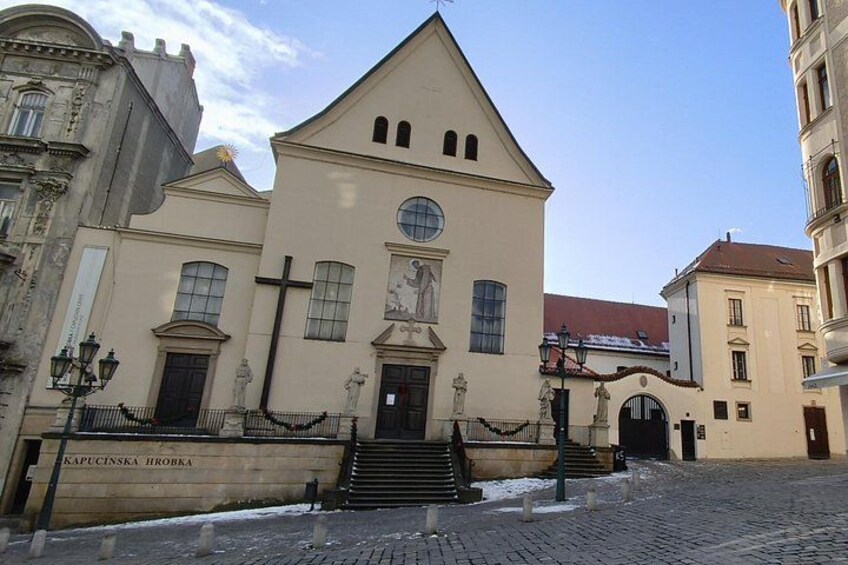
Kapucínské náměstí (Capuchin Square) is located in the centre of Brno and is best known for the Holy Cross Church, dedicated to the Holy Cross. The church was founded in the 1650s and belongs to the Order of Friars Minor Capuchin. It is an important example of Baroque sacred architecture in Brno and is part of the Diocese of Brno. The church is included in a cultural monument and lies at an altitude of 218 m.
Beneath the church lies the famous Capuchin Crypt, which served as a burial place for members of the order and local nobility. It houses unique historical tombstones and mummies, which attract visitors’ interest.
If you are interested, I can show you the entrance to the crypt and advise you where to buy tickets. Tickets are not included in the price of this tour.
Moravian Museum - Bishop’s Courtyard
- 6m
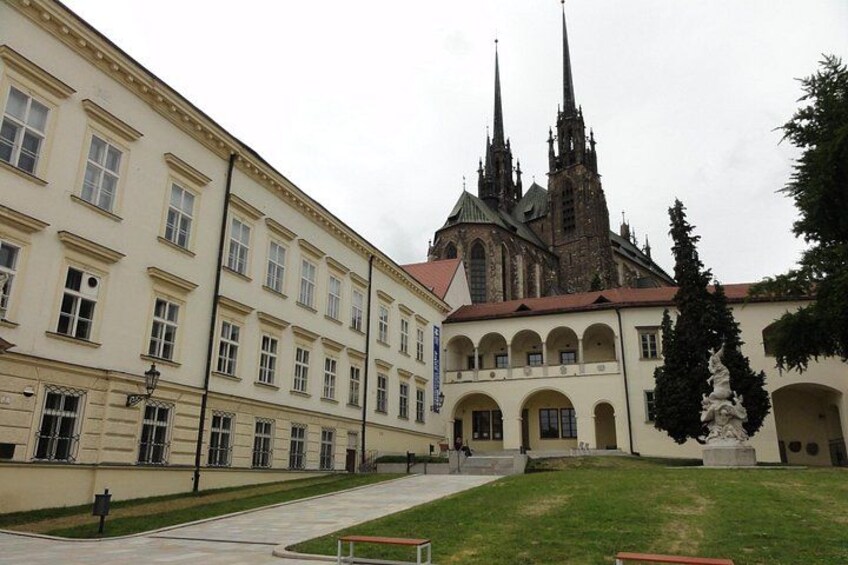
The Bishop's Court is located in the historic centre of Brno, near Freedom Square (Náměstí Svobody). The area has been urbanised since the Middle Ages, and it has served as the seat of the Bishop of Brno since the 17th century. The square and adjacent areas are among the city's important historical monuments.
The courtyard features a sculpture from the Mercury Fountain, originally dating from 1699. The fountain originally stood on Freedom Square (Náměstí Svobody), but it fell into disrepair and was not restored. In 1867, the fountain was removed, and the sculpture was donated to the Moravian Provincial Museum, which placed it in its current location.
The sculpture is an important example of Baroque art and continues to attract visitors with its artistic and historical significance.
Denis Gardens
- 5m
Denisovy sady (Denis Gardens) are located on the southeastern slope of Petrov Hill in Brno . It is the first public park in the Czech Crown Lands created by the public authorities. The work on the park began after 1805 at the initiative of the Moravian governor Count Prokop Lažanský, with the involvement of Scottish architect Lord James Ogilvy Findlater.
In 1818 an obelisk was unveiled to commemorate the Austrian Empire's victory over Napoleon. The park was officially founded and named Františkův. A late Classicist colonnade with a fountain from the mid-19th century stands nearby. The park also includes a Neo-Romanesque water tower built in 1818, which supplied drinking water until 1873 and was reconstructed in 2005.
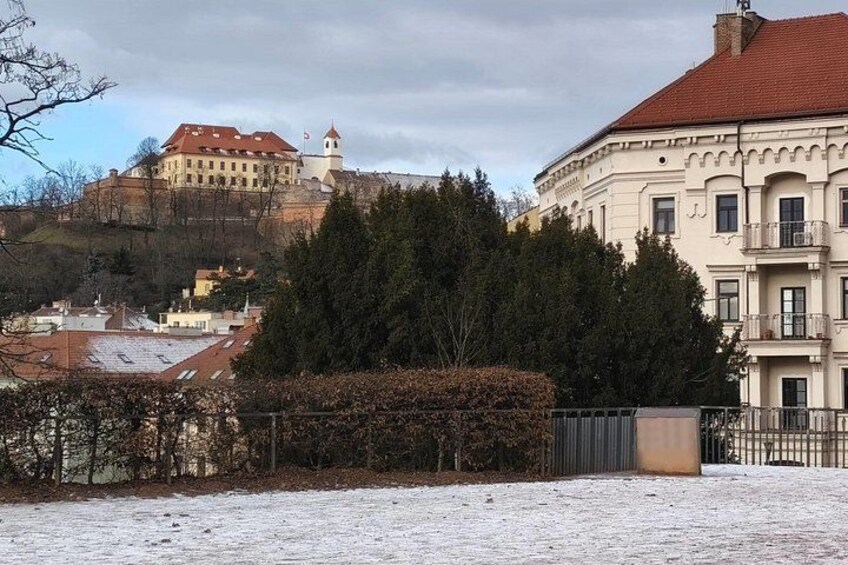
In 1919, the park was renamed Denis Gardens in honour of French historian Ernest Denis. Denis Gardens now offers panoramic views of the southern and southwestern parts of Brno including the tallest building in the Czech Republic, AZ Tower
Dohoda Beer House
- 1m
We are approaching Dohoda Beer House, a pub offering craft beer. The establishment is known for its selection of beers from smaller Czech breweries, especially KOS Brewery, and features a pleasant interior and a summer garden. It is a quiet place popular with locals.
Cathedral of St. Peter and St. Paul
- 20m
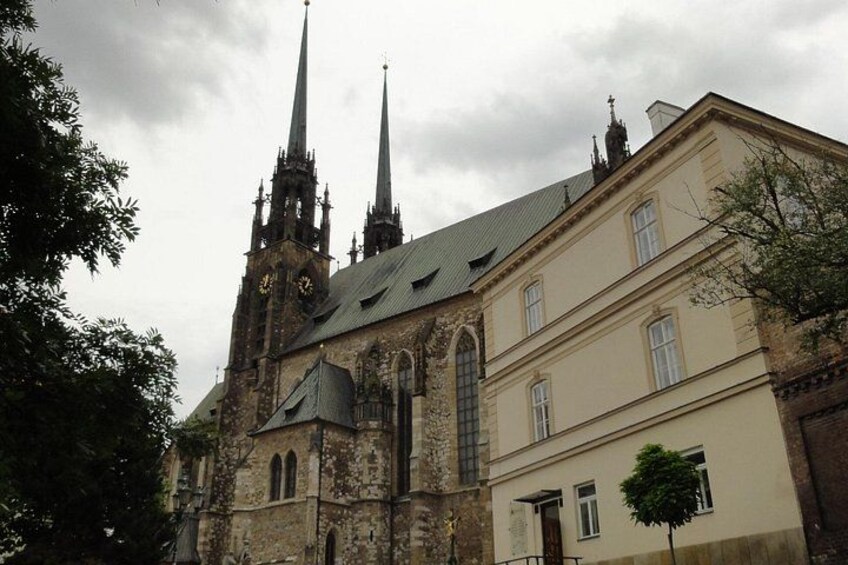
Our last stop is St. Peter and Paul Cathedral, dedicated to the apostles Peter and Paul, a prominent symbol of Brno on Petrov Hill.
The original Romanesque church, built in the late 12th century, was rebuilt as a basilica in the 13th century.
The cathedral’s artistic high point came with Baroque modifications in the 17th and 18th centuries.
Its present appearance reflects a long development, combining a Gothic core with Baroque interior alterations.
A characteristic feature is the pair of slender towers, approximately 84 metres high, whose current form dates to the early 20th century and is visible across much of the city.
The cathedral is closely linked to the history of Brno and Moravia; its silhouette appears on the Czech ten-koruna coin. Another notable tradition is the ringing of the bells at 11 a.m. instead of noon.
Separate tickets are available for the towers with city views and for the treasury.
We conclude here and thank you very much for joining our tour of Brno.
Location
Activity location
- Socha Odvaha
- Moravske nam. 611/6
- 602 00, Brno, Czech Republic
Meeting/Redemption Point
- Equestrian Statue of Margrave Jobst of Luxembourg
- 6 Moravské náměstí
- 602 00, Brno-střed, Jihomoravský kraj, Czechia
Best Deals on Things to Do
Experience the wonders of the world up close with great deals on things to do near and far. Expedia offers one-of-a-kind activities that allow you to explore Brno your way. Whether you love nature, culture, food or a bit of adventure, we have the perfect activity for you.
Top experiences in Brno
With so many things to do in Brno, planning the perfect day out may seem like a daunting task. Expedia is here to take the hassle out of finding the best attractions, tours and activities in Brno. Families, couples and business travellers can all find the perfect activity in Brno to create life-long memories with the help of Expedia.